Monday, April 14, 2014

Final Reading Schedule: April 17- May 6

Stephen King: The Shining (1977)

April 17, Thursday: No Class-- Student Conferences (office hours from 1-5 p.m.)                                                   

April 22, Tuesday: Short Essay #2 DueChapters 1-30     

April 24, Thursday: Chapters 31-40             

April 29, Tuesday: Chapters 41-50

May 1, Thursday: Chapters 50-58 

May 6, Tuesday:                      
Short Assignment #3 Due: Proposal; Class Wrap Up   

May 12, Monday:          
Extended Analysis Due

Quotation Integration Examples

Original Passage:

“I could not stir even a finger; I could not lift my voice; I could not even breathe, and though I expected every moment to see the sleeping  man murdered, I could not even close my eyes to shut out the horrible spectacle, which I had not the power to avert” (Le Fanu 125).

Quotation Integration:

Although the narrator “expected every moment to see the sleeping man murdered,” she is unable to move, speak, breathe, or even shut her eyes against the “horrible spectacle” which she “had not the power to avert” (Le Fanu 125).

Fear acts as a supernatural power, disabling the narrator from “stir[ring] even a finger,” or “lif[ting] [her] voice,” or even closing her “eyes to shut out the horrible spectacle” (Le Fanu 125).

The narrator recounts the attack she thought was directed at her husband, remembering that when “the horrible spectacle” occurred, “I could not stir even a finger; I could not lift my voice; I could not even breathe” (Le Fanu 125).

Monday, April 7, 2014

Man's Dual Nature

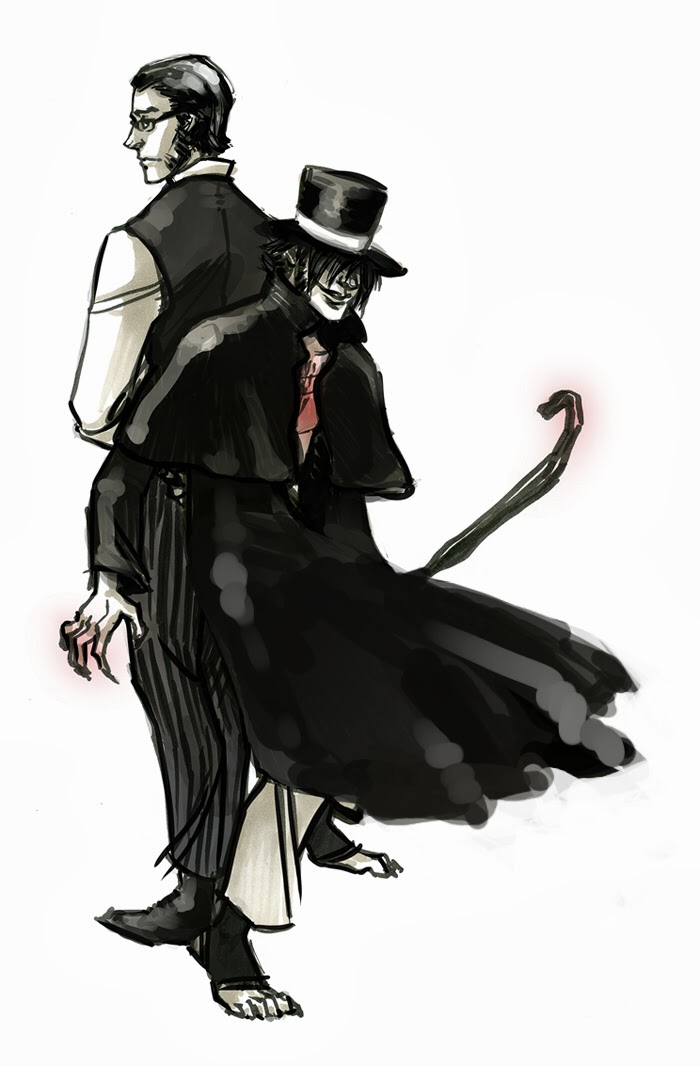
What about the story of Jekyll and Hyde has intrigued audiences for so long, so much so that visual representations of the dual natures of this character are still recreated in pop art and film? How does the case of Jekyll and Hyde revise or expand upon the Frankenstein story?

"With every day, and from both sides of my intelligence, the moral and the intellectual, I thus drew steadily nearer to that truth by whose partial discovery I have been doomed to such a dreadful shipwreck: that man is not truly one, but truly two. I say two, because the state of my own knowledge does not pass beyond that point. Other will follow; others will outstrip me on the same lines; I hazard the guess that man will be ultimately known for a mere policy of multifarious, incongruous and independent denizens. It was on the moral side, and in my own person, that I learned to recognise the thorough and primitive duality of man; I saw that, of the two natures that contend in the field of my consciousness, even if I could be rightly said to be either, it was only because I was radically both" ("Henry Jekyll's Full Statement of the Case").

A quote on this issue from G.K. Chesterton (scholar, critic, and theologian) in an essay reviewing Robert Louis Stevenson's body of work:
"You will find twenty allusions to Jekyll and Hyde in a day's newspaper reading. You will also find that all such allusions suppose the two personalities to be equal, neither caring for the other. Or more roughly, they think the book means that man can be cloven into two creatures, good and evil. The whole stab of the story is that man can't: because while evil does not care for good, good must care for evil. Or, in other words, man cannot escape from God, because good is the God in man; and insists on omniscience. This point, which is good psychology and also good theology and also good art, has missed its main intention merely because it was also good story-telling."


There have also been modern reinventions or adaptations of the Jekyll and Hyde story that refigure the "Hyde" as the physically superior version of the brainy, but more diminutive, "Jekyll." The Nutty Professor, a comedic retelling (in both the original 1963 and 1996 versions) make different distinctions about character and physicality. Below is the trailer and a scene from the original The Nutty Professor. How do these more modern and American adaptations refigure the physical depictions of good and evil? How is this different thematically than the British preoccupations with appearance as a direct signifier of good or evil character?

The Nutty Professor (1963) Trailer

Criminal Photography

Friday, April 4, 2014

Extra Credit Assignment

In Dracula, Lucy Westerna is silenced by her condition as her death approaches and Dr. Seward primarily narrates her final days. For this extra credit assignment, you will write a minimum two page creative piece that is narrated by Lucy Westerna and represents the experience of the period just before her death. This assignment asks you to imagine that an additional narrative was found—diary entry, letter, etc.— composed by Lucy before her death. Keep your creative piece within the parameters of the world of the novel; stay consistent with the details of the surrounding story. Other than that, you are free to imagine Lucy’s experience. Possibilities for subject matter can range from the Dracula attacks, to her emotional response to impending death, to her understanding of her transformation into a vampire. 

The due date for this assignment is April 18 (Friday), although you may turn it in anytime between now and then. You may turn in either a hard copy or email submission of this assignment. If you email the assignment, name the file Late Name-EC.docx. This assignment will be worth a maximum of 30 additional points, depending on the quality of the work. 

Thursday, April 3, 2014

Victorian Art and Advertisements


C.J Staniland, Dollmakers and Dollbreakers from The Graphic Magazine Christmas Number (1878)
William Logsdail, St. Paul's and Ludgate Hill (1887)

Wood engraving from the Report of the Commission on the Employment of Young Persons in the Mines (1842)
John O'Connor, From Pentonville Road Looking West: Evening (1884)


Advertisement for William Barker's, London, showing the correct outdoor wear for a widow in the first stages of mourning (1900)

Alfred Morgan's An Omnibus Ride to Piccadilly -- Mr. Gladstone Travelling with Ordinary Passengers (1885)

Charles March Gere, The Tennis Party (1900)

Franz Xavier Winterhalter, The First of May, 1851. 

Tuesday, April 1, 2014

Reading Schedule: April 3-15

The Strange Case of Dr. Jekyll and Mr. Hyde, Stevenson
April 3, Thursday: Chapters 1-5.
April 8, Tuesday: Chapters 6-10; and pdf. selections from "Night Walks," Dickens; and "Decline of the English Murder," Orwell.

Hauntings
April 10, Thursday: "A Chapter in the History of the Tyrone Family," Le Fanu; 218-244. GT
April 15, Tuesday: "Barbara of the House of Grebe," Hardy; 102-32. GT

Short Essay #2 and Short Assignment #3


Short Essay #2: Due Tuesday, April 22nd (electronic copy)
For the second short essay, you will write a 3-4 page critical paper on one of the full length texts- Beloved by Toni Morrison, Dracula by Bram Stoker, The Strange Case of Dr. Jekyll and Mr. Hyde by Robert Louis Stevenson, The Hound of the Baskervilles by Sir Arthur Conan Doyle or The Shinning by Stephen King. 

This short essay will focus specifically on a critical issue*, will be organized around your topic, and will include an introduction that clearly sets up your intention for the paper. Create a literary argument that provides a framework for interpreting the text and explains one of the novel's larger themes. In this argument, you are advocating a specific and non-obvious “reading of the text”- an argument about how the story can be read and understood. You will select one to two literary elements and discuss their significance for a larger theme or issue within the novel.  Your discussion of the literary elements will not be an end unto itself, but will ultimately prove their significance to the critical issue you identify. Your essay should also incorporate textual evidence and a discussion of this evidence, including integrated direct quotations to support your claims (in MLA format).

Additional guidelines: Use MLA style for paper formatting, works cited, and direct citations. An electronic copy of your paper is due via email by 2 p.m. for section -030 and 3.30 p.m. for section -033. For this assignment, you will name the file: Last Name-SE2.docx.
* The critical issue: A problem your essay resolves through careful interpretation of the novel. The more focused your problem, the better your chance of writing a successful essay.
Three stage process for defining the critical issue:
  1. Organize your general response notes into an area of investigation (such as point of view, style, imagery, etc.); 
  2.  Find a specific topic within that area, such as how point of view, imagery, etc. contribute to your interpretation of the story; and 
  3.  Decide on a thesis- what you intend to prove by exploring your topic.

Short Assignment #3: Due Tuesday, May 6th (Electronic Copy)
Create a 250-350 word proposal defining your plans for the final essay. A proposal is a persuasive document that provides a concise and clear idea of the literary argument you will pursue in your final longer essay. This short assignment will ensure that you are thinking about your final essay early on, and can receive feedback on your ideas early enough to make changes if necessary. Your proposal should provide answers to the following questions:
  1. What is your working thesis?
  2. What is your thematic focus within the text/s you are analyzing?
  3. Which parts of the text/s will be your key focus points and why?
If you decide to revisit one of your previous essays, you should include ways that you will expand upon your argument, address problems in your original essay, or provide a short plan for revision (considering the feedback you have received from me). 
The argument you will take in your final paper should be clear in this assignment; however, this document is not binding. As you write, you may find that the argument you initially thought you were pursuing takes a different course. This is perfectly acceptable and part of the writing process.

Additional Guidelines: Use MLA style for paper formatting. An electronic copy of your paper is due via email by 2 p.m. for section -030 and 3.30 p.m. for section -033. For this assignment, you will name the file: Last Name-SA3.docx.